
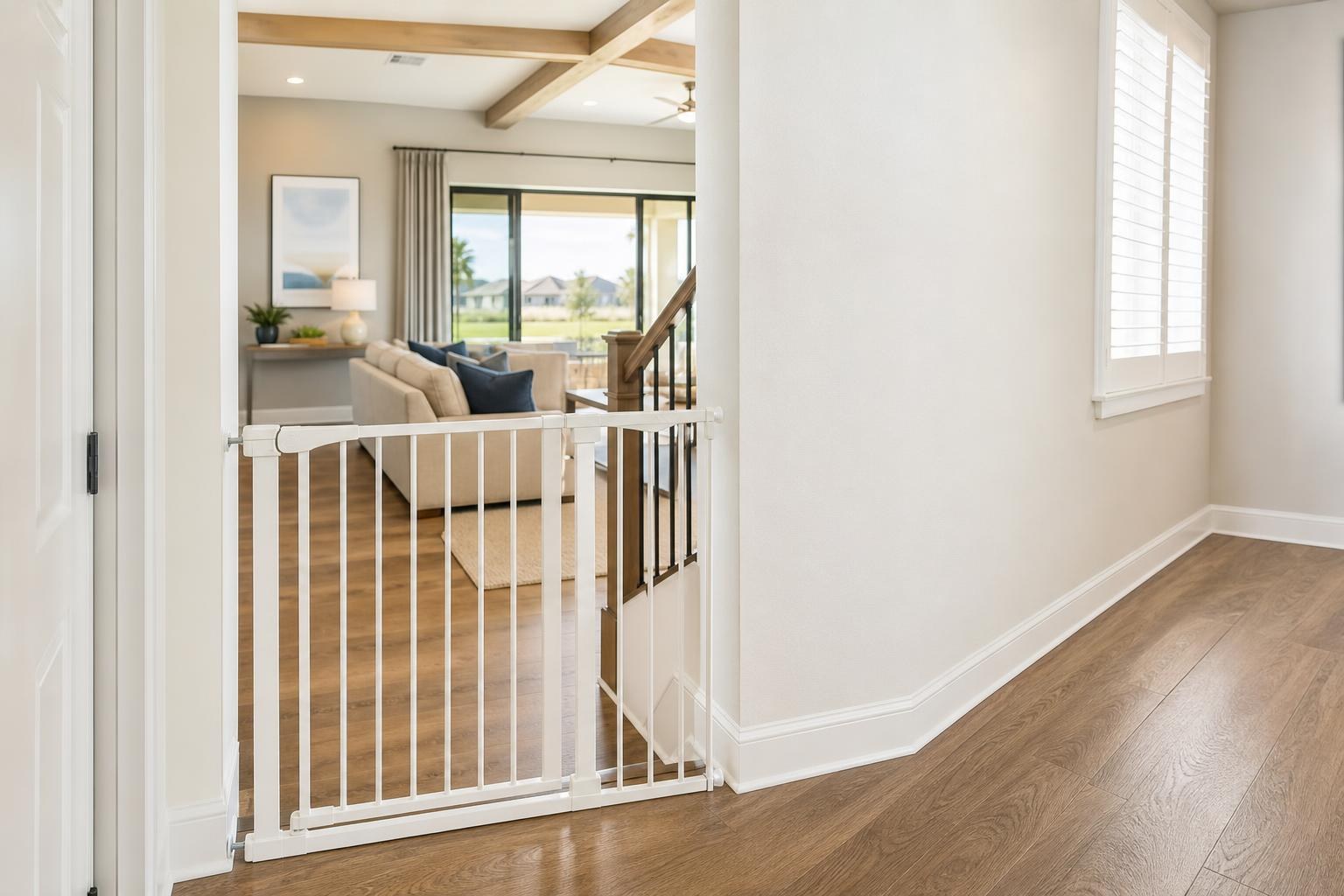
Child Safety Gate Installation: Where to Place It and How to Prepare Your Home
September 5, 2026
You may already know where you want a child safety gate, but that does not automatically mean every gate will work there. A pressure-mounted gate that fits between two hallway walls may be inappropriate at the top of a staircase. A gate advertised for a particular width may not account for baseboards, angled trim, or an irregular banister.
Before buying a gate or scheduling installation, it helps to evaluate the opening, the surrounding surfaces, and how people will move through the space. Better preparation can prevent ordering the wrong product, creating an inconvenient walkway, or discovering that the intended mounting points are unsuitable on installation day.
Here is what homeowners, renters, and property managers should consider when planning a child safety gate installation.
Start With the Hazard, Not the Most Convenient Doorway
A gate should limit access to a specific hazard or area. That may include a staircase, kitchen entrance, home office, laundry area, fireplace zone, or room containing fragile furniture and electronics. Think about where the child will normally be and which boundary creates a practical, supervised space.
For stairs, access may need to be controlled at both the top and bottom. The two openings can require different products because the mounting surfaces, traffic patterns, and consequences of gate movement are different.
Also consider daily use. Adults should be able to operate the gate as intended without climbing over it, and the open gate should not block another doorway or create an awkward path. If the location is so inconvenient that household members are likely to leave the gate open, a nearby opening may be more practical.
Match the Gate Type to the Location
Child safety gates generally fall into pressure-mounted, hardware-mounted, and retractable or specialty designs. Product labels and manufacturer instructions should identify the locations for which a particular model is intended.
At the top of stairs, use only a hardware-mounted gate specifically approved by its manufacturer for that application. Pressure-mounted gates can shift when pushed and often have a bottom rail that creates a tripping concern. They should not be treated as interchangeable with stair-rated hardware-mounted models.
Pressure-mounted gates may be suitable for certain level openings between rooms when used according to the product instructions. Retractable and specialty gates vary considerably, so confirm that the exact model is approved for the intended location rather than relying on its general appearance or marketing category.
When comparing products, review:
- The manufacturer’s approved installation locations
- The exact supported opening-width range, including any extensions
- The permitted mounting surfaces and hardware requirements
- Whether the gate swings in one direction or both
- The latch location and adult operating method
- Current product labeling, safety information, and recall status
A pet barrier is not automatically a child safety gate. Decorative openings, flexible materials, footholds, or a latch intended only to contain an animal may not be appropriate for a young child.
Measure More Than the Width
One width measurement is rarely enough. Walls can be slightly out of square, baseboards can narrow the bottom of an opening, and chair rail or decorative trim can affect where mounting hardware sits.
Measure the opening near the floor and at the expected upper mounting height. Note which surfaces are drywall, wood trim, masonry, metal railing, or another material. If the opening has a post on one side and a wall on the other, photograph both sides clearly.
Stair openings deserve additional attention. Banisters may be round, tapered, decorative, or positioned at an angle. Avoid assuming that drilling directly into a railing is the only option. Some gate manufacturers offer compatible banister adapters or mounting kits, but those accessories must match the gate and the specific application.
If no manufacturer-approved configuration fits the opening, do not improvise with scrap wood, adhesive strips, furniture, or unrelated hardware. A different gate or location may be the safer choice.
Inspect the Mounting Area Before the Appointment
A gate depends on the condition of the surfaces around it. Loose trim, damaged drywall, unstable railings, or heavily textured walls can interfere with proper placement. Check the area in good lighting and disclose visible damage when requesting a quote.
Move baskets, small furniture, toys, and floor mats away from the opening. Nearby furniture should not give a child an easy climbing route around or over the gate. If the gate will swing into a room, verify that it will clear door handles, cabinets, appliances, and wall decor.
Existing holes or wall damage may need separate attention. USA Handyman Pros offers drywall patching and wall repair for suitable cosmetic repairs, but the repair and gate installation should be evaluated as separate project needs. A cosmetic patch is not a substitute for a secure mounting surface required by the gate manufacturer.
Stair Gates Require Extra Planning
Stair placement has little room for guesswork. In addition to choosing a model specifically approved for the location, consider gate swing direction, latch access, handrail clearance, and nearby steps.
A top-of-stairs gate should not swing out over the staircase. The manufacturer’s required mounting position and clearances should govern the installation. If those requirements cannot be met because of the stair layout, trim, railing design, or wall condition, stop and choose another approved solution rather than modifying the gate.
At the bottom of stairs, install the gate where intended by the manufacturer and consider whether a bottom threshold will sit in a normal walking path. The goal is to control access without introducing an avoidable trip point.
No gate replaces adult supervision. Gates should be checked regularly for movement, loose components, damage, or changes in fit, especially as a child becomes stronger or begins climbing.
What Affects Child Safety Gate Installation Pricing?
There is no single listed price that applies to every gate installation. Final pricing varies because a straightforward level doorway is different from a stair opening with angled trim and a banister adapter.
Common pricing factors include the number of gates, gate style, opening dimensions, mounting-surface condition, required manufacturer-compatible accessories, stair or banister complexity, removal of an old gate, and whether separate wall touch-ups are requested.
Buying the gate before confirming compatibility can be expensive if it must be returned. If you are uncertain, collect the opening dimensions and product link first. A handyman can review the project information and identify questions that should be resolved before the appointment.
What to Include With Your Quote Request
Clear information makes it easier to evaluate the project and helps reduce appointment-day surprises. For each opening, provide:
- A straight-on photo showing the complete opening
- Close photos of both proposed mounting sides
- Width measurements at the bottom and expected upper mounting area
- The gate brand, model number, product link, and available accessories
- Whether the location is at the top or bottom of stairs
- Details about baseboards, banisters, trim, existing holes, or visible damage
- Whether the home is owner-occupied, rented, or professionally managed
Renters should obtain permission before scheduling an installation that requires holes or other permanent attachment. Property managers may also want to document the approved gate model, installation location, and expectations for removal or wall repair after the tenancy.
When Hiring a Handyman Makes Sense
Professional help is especially useful when the opening includes uneven trim, multiple surface types, a banister, limited swing clearance, or several gates that need to work together. It can also help busy families and property managers avoid spending an appointment sorting through incompatible parts or incomplete measurements.
USA Handyman Pros handles child-safety gate installation and related non-regulated handyman projects for homeowners, rentals, property managers, and businesses. Current Central Florida coverage includes Marion, Levy, Citrus, Alachua, and Orange counties, along with nearby communities.
Before booking, confirm that you have the complete gate, required manufacturer-supplied hardware, extensions, and compatible mounting accessories. Do not substitute unrelated fasteners or adapters for parts specified by the gate manufacturer.
Ready to plan your installation? Send photos, measurements, and the gate model through the instant quote form, or book USA Handyman Pros online. You can also call (352) 462-0943 to discuss the project details.
Ready to Get the Project Off Your To-Do List?
From furniture assembly and TV mounting to drywall repair, painting, pressure washing, accent walls, shelves, pictures, mirrors, and other approved handyman projects, USA Handyman Pros can help you turn the list into finished work.
USA Handyman Pros
(352) 462-0943
Project scope, materials, access, surface conditions, travel, availability, and final pricing can vary. Starting prices are not final quotes. Work requiring a licensed trade professional is outside the scope of this automated handyman content.